
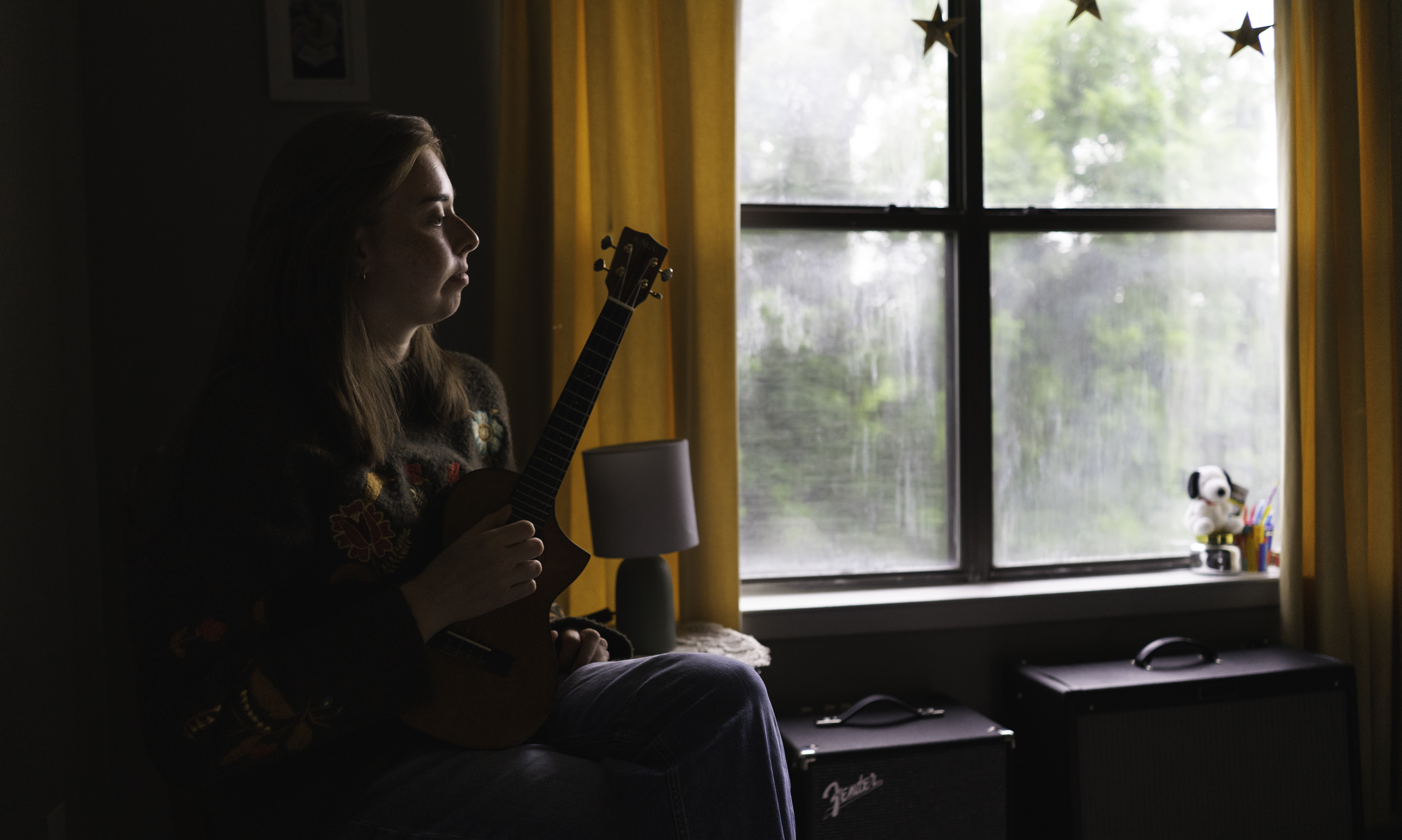
Charissa Hoffman is a sixth-generation musician from Nashville, but the instrument she chose was the one plenty of people still mistake for a toy. She took the ukulele to Berklee College of Music, became the first ukulele principal the school ever accepted, and built a sound out of jazz chords, hypnotic picking, Appalachian roots, and the little instrument's strange, ringing high G string.
Her debut album, Horizon, is out now. Produced by John Mailander, it features Béla Fleck, Abigail Washburn, Chris Eldridge, and Nina de Vitry. The names will get your attention. Hoffman's story is what should hold it: a young musician who heard "no" often enough to turn it into fuel, then made a debut record about the family history carried in her blood.

Ed’s take
Some records you put on to be impressed. This one I put on to cook by.
Horizon is exactly the kind of album that lives at my house in the early evening, a glass of white wine on the counter, something on the stove, the day finally slowing down. Charissa’s playing is beautiful in a way that sneaks up on you. A track like “Parallel Lines,” which closes the record, is just hauntingly beautiful, the kind of song that makes a kitchen go quiet for a minute.
But here is what I keep coming back to. What gets lost in the beauty of her sound is the songwriting. It would be easy to hear the ukulele, the picking, those big-name guests, and treat this as a player’s record. Listen closer and it is a writer’s record. “If I Could Fly,” the song she points folks to first, wrestles with where she came from and still lands hopeful. “Who Am I” asks its question right out loud. These are songs about family, guilt, gratitude, and getting above your raising, written by somebody who has clearly sat with all of it.
Pretty records are common. Pretty records with something to say are not. This one is both.
Let’s start at the front door. You are a sixth-generation musician from Nashville who built her sound around the ukulele, an instrument most people think of as a novelty. For a reader meeting you on this record, how do you describe what you do?
Mostly I just mess around, but musically I try to paint a scene with my work. I like jazz chords and hypnotic picking techniques because they evoke such visceral emotions and my goal with my music is to put the listener in another time and place, whether that’s escapism or allowing them to process real feelings in a separate space from their day-to-day life. I come from a long line of musicians running the gamut from classically trained to Appalachian fiddlers to electric blues, and I’m grateful for all of those influences.
You were the first ukulele principal ever accepted at Berklee College of Music, after years of people telling you to just learn guitar. What kept you stubborn about four strings, and what can a ukulele do that a guitar cannot?
I do not like hearing “no.” I went through my college auditions partly because I believed in the ukulele, and partly I just wanted to prove everybody wrong. That spite will only get you so far, though, and once I was accepted to Berklee I had to spend a year working three jobs before I could afford to enroll. That kind of motivation can only come from loving and believing in something, I think.
I’m really intrigued by the ukulele’s re-entrant string. A lot of the picking patterns and open tunings on my record highlight that anomaly. I always wanted to find what made the ukulele distinctive, and not just a guitar with fewer notes. I think the secret is in that high G string and the harmonic options or campanella style it can accomplish.
Horizon is your debut album, out October 16, produced by John Mailander. For a first-time listener, what is this record about, and which track should they start with?
I wrote these tunes throughout the pandemic and those first few years following. A lot of us were cooped up and alone with our thoughts, and I started thinking about my family history and how it affects me today. I studied Roots music at Berklee and met a lot of folks who seemed to romanticize the moonshiners and battered wives and lonesome fiddlers that frequent folk songs, but in my family history those stories were sources of shame and deep pain. Even a few generations removed from the West Virginia coal mines, I find myself feeling both guilt and anxiety, guilt for having such a better life than my foremothers, and anxiety about sliding right back into that pit of poverty and isolation. Nothing is guaranteed. These songs are about grappling with those feelings, the different experiences and beliefs I'm privileged to hold, and the fear I'm disappointing my ancestors or that our bloodline is destined to fail. I think I'd recommend starting with "If I Could Fly" as it wrestles with both of these sides, but ends on a hopeful note.
The guest list reads like a hall of fame for new acoustic music: Béla Fleck, Abigail Washburn, Chris Eldridge, and Nina de Vitry all play on a debut ukulele record. How did those players end up in the room, and what did you learn standing next to them?
I was friends with Nina in Boston and we connected over our solo work in Nashville. We both love jazz and folk songwriting and struggle with finding our spot in the genre divide. I actually know the Fleckburns and Critter through their children. It's a long story, but one of my Berklee connections recommended me as a sitter and so I got to know them from more of a family perspective before we made music together. I was intimidated to make the leap and ask them to play on my record, but they've been so incredibly supportive and kind from day one. I am so inspired and humbled by all of their collaborative spirit and how much we were all focused on serving the music at hand, rather than being motivated by ego.
"Kitchenette" is the album's one full instrumental, and you built it around what the ukulele does best instead of forcing show-off tunes onto it. Walk us through how a piece like that gets written on four strings.
To be honest, it just sort of happened. I can hear a lot of what I was listening to at the time bleeding through, weird "hits" or time feels that all come back home to 4/4, melodic and harmonic departures that resolve into C major. I'm definitely influenced by the Flecktones in that but also a lot of traditional Celtic music counts out to 4 or 8 beats, but has emphases on the 3rd, 5th or 7th beats. The tune is inspired by a dream I had and I wanted to capture that frenetic, fever-dream energy in the first part but resolve to a peaceful, restful melody in the second.
You have spent years teaching the ukulele as well as playing it. If one of my readers picks one up this weekend because of this record, what is the first thing you would tell them?
Don't do it!! Your loved ones will never see you again!! Your boyfriend will beg you to come to dinner but you will be consumed by transcribing Coleman Hawkins riffs late into the night!! Just kidding. I would say, the amazing thing about uke is that it is what you make it. Instruments like piano and guitar come with so much pedagogy, but ukulele is still an open book. You can turn into a mega-nerd like me and try to learn the hardest stuff you can, or you can strum simple chords to accompany your voice. There's no wrong answer, it's all about how it makes you feel!
Horizon is out now.
If you enjoy discovering new music, pass this along.
Photo credit: Trey Schueler
